|
|
| FoAR DeepTagPhoto:基于预训练 CNN 模型的专家引导式泰国建筑摄影无监督聚类 |
|
论文标题:DeepTagPhoto: Expert-guided unsupervised clustering of Thai architectural photography using pre-trained CNN models
期刊:Frontiers of Architectural Research
作者:Walaiporn Nakapan, Chi-tathon Kupwiwat, Chavanont Khosakitchalert
发表时间:30 Sept 2026
DOI:10.1016/j.foar.2025.09.012
微信链接:点击此处阅读微信文章

FoAR是由高等教育出版社和东南大学建筑学院联合主办的全英文学术期刊
建筑学 / 城乡规划 / 风景园林
本刊已被 A&HCI / EI / CSCD / Scopus / DOAJ / CSTPCD 收录
中国科技期刊卓越行动计划 英文领军期刊
Manuscript Title
论文题目
DeepTagPhoto: Expert-guided unsupervised clustering of Thai architectural photography using pre-trained CNN modelsDeepTagPhoto:基于预训练 CNN 模型的专家引导式泰国建筑摄影无监督聚类
Authors
作者
Walaiporn Nakapan, Chi-tathon Kupwiwat* , Chavanont Khosakitchalert
Architectural Intelligence (A.I.) Research Group, Department of Architecture, Faculty of Architecture, Chulalongkorn University, Bangkok 10330, Thailand
Abstract
论文摘要
This study presents an unsupervised image clustering approach to support expertled analysis and tagging of traditional Thai architectural photography. This study evaluates how effectively deep-feature clustering derived from pre-trained CNN embeddings reveal meaningful groupings within Thai stupa photography without relying on existing labels. A subset of 824 images depicting stupas was selected from an original academic archival 7696-image dataset in order to investigate the feasibility of clustering based on deep features extracted from four pre-trained Convolutional Neural Networks (CNNs): VGG19, ResNet50, DenseNet, and InceptionV3. These embeddings were clustered using the K-means algorithm, and results were validated qualitatively by a domain expert. Among the models, ResNet50 achieved the lowest rejection rate and highest alignment with expert interpretations. Notably, the experts engagement with the clustering outputs led to the revision of prior annotations, revealing instances of label noise and enhancing intra-cluster specificity. These findings suggest that CNNbased clustering can mitigate the limitations of expert-dependent tagging, namely incompleteness, subjectivity, and inconsistency while offering a generalizable framework for similar heritage datasets with sparse or noisy labels. The study contributes a hybrid human-AI methodology for visual cultural heritage analysis and highlights opportunities in supervised style classification and automated archiving workflows.
本研究提出一种无监督图像聚类方法,为专家开展泰国传统建筑影像分析与标注工作提供支持。本研究评估了在不使用现有标签的情况下,由预训练卷积神经网络嵌入向量得到的深度特征聚类能否在泰国佛塔影像中划分出具有研究意义的图像组别。研究从包含 7696 张影像的原始学术档案数据集中选取 824 张佛塔图像作为子样本,基于 VGG19、ResNet50、DenseNet 和 InceptionV3 这四种预训练卷积神经网络提取深度特征,以此探究该聚类方法的可行性。研究采用 K 均值算法对这些嵌入特征进行聚类,并由相关领域专家对结果开展定性验证。在所有模型中,ResNet50 模型的剔除率最低,聚类结果与专家判读结果的契合度最高。值得注意的是,专家在参考聚类结果的过程中对原有标注进行了修正,发现了标签噪声问题,提升了簇内特征的区分度。研究结果表明,基于卷积神经网络的聚类方法能够改善仅依靠人工标注所存在的信息不全、主观性强、标准不统一等缺陷,同时为标签稀缺或标签存在噪声的同类遗产数据集提供一套可推广的分析框架。本研究提出一套面向视觉文化遗产分析的人机协同研究方法,也为建筑风格的有监督分类与自动化档案管理流程挖掘出更多应用可能。
Keywords
关键词
Convolutional neural network / 卷积神经网络
Unsupervised learning / 无监督学习
Traditional art and architecture / 传统艺术与建筑
Visual clustering / 视觉聚类
Human-AI collaboration / 人机协同
Sections Title
章节标题
1. Introduction / 引言
1.1. Background and research challenges / 研究背景与挑战
1.1.1. Context and recent advances / 研究背景与最新研究进展
1.1.2. Challenges in expert tagging of cultural heritage images / 文化遗产图像专家标注存在的难题
1.1.3. Research gap / 研究空白
1.2. Research objective and question / 研究目标与研究问题
1.3. Research contributions / 研究贡献
2. Related research on CNN?based classification of art and architectural images / 基于卷积神经网络的艺术与建筑图像分类相关研究
2.1. CNNs as tools for image classification / 作为图像分类工具的卷积神经网络
2.2. Representative CNN models for visual feature extraction / 用于视觉特征提取的代表性卷积神经网络模型
2.3. Unsupervised clustering and expert?guided interpretation in cultural heritage imaging / 文化遗产影像领域的无监督聚类与专家引导式解读
3. The dataset / 数据集
3.1. The importance of the dataset / 数据集的研究价值
3.2. The primary dataset for investigation / 研究所用主数据集
4. Methodology / 研究方法
4.1. Image embedding / 图像嵌入
4.2. Unsupervised K?Means clustering / K?均值无监督聚类
4.3. Human expert evaluation / 领域专家人工评估
4.3.1. Review environment / 评审环境
4.3.2. Evaluation criteria / 评价标准
4.3.3. Rejection process / 图像剔除流程
4.3.4. Qualitative refinement / 定性优化
4.3.5. Reliability / 信度
5. Results / 实验结果
6. Conclusion and discussion / 结论与讨论
6.1. Addressing labeling challenges through unsupervised clustering / 基于无监督聚类解决标注难题
6.1.1. Minimizing incomplete tagging through reviewing clusters / 通过聚类结果审查缓解标注不完整问题
6.1.2. Identifying and filtering noisy labels through visual verification / 通过视觉校验识别并过滤标签噪声
6.1.3. Mitigating subjectivity through pattern emergence / 通过模式挖掘降低标注主观性
6.2. Methodological limitations / 方法局限性
6.3. Generalizability of the method / 方法的可推广性
6.4. Future directions and practical applications / 未来研究方向与实际应用
Illustrations
主要插图
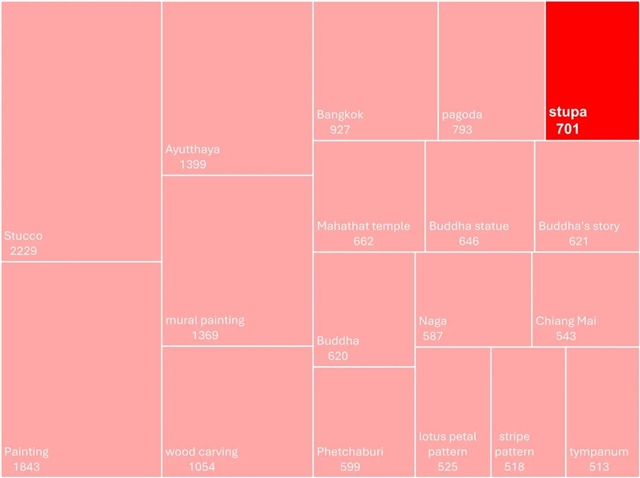
▲ 图 1:高频图像标签树状图。©本文作者
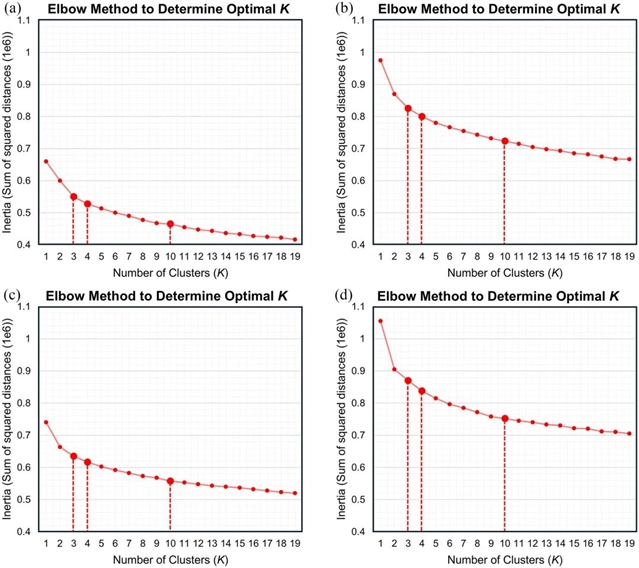
▲ 图 2:聚类数量变化时的代价函数:(a) VGG19,(b) ResNet50,(c) DenseNet,(d) InceptionV3。©本文作者
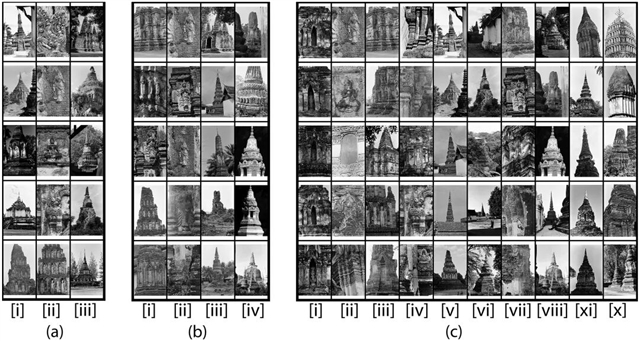
▲ 图 3:VGG19 模型不同聚类条件下的图像示例:(a) 聚类数 K=3,(b) 聚类数 K=3,(c) 聚类数 K=10。©本文作者
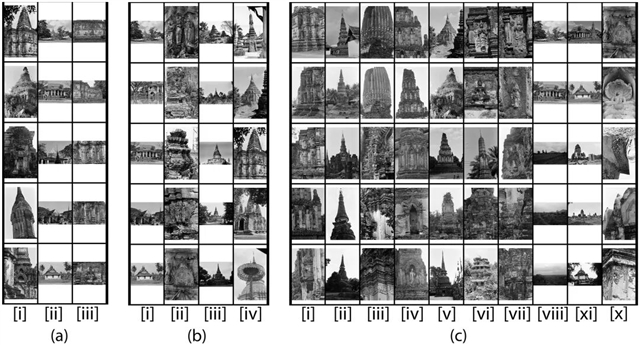
▲ 图 4:InceptionV3 模型不同聚类条件下的图像示例:(a) 聚类数 K=3,(b) 聚类数 K=3,(c) 聚类数 K=10。©本文作者
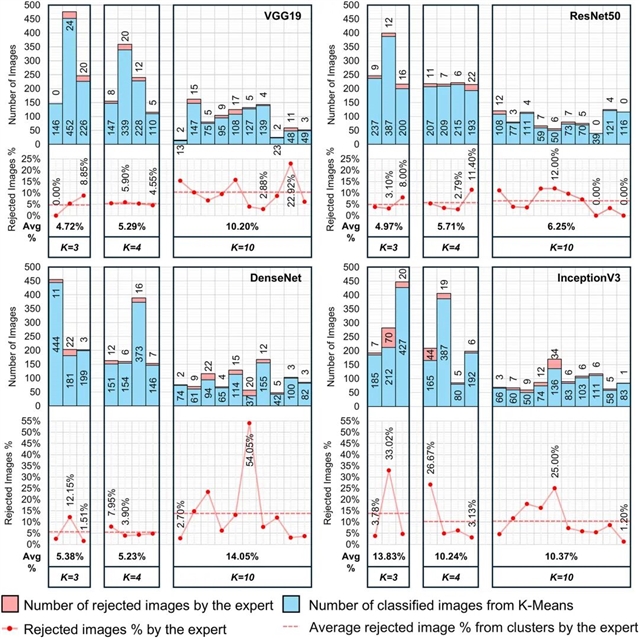
▲ 图 5:专家评估结果可视化(各聚类下的剔除图像及对应统计数据)。©本文作者
Authors Information
作者简介

Walaiporn Nakapan
Assistant Professor
Architectural Intelligence (A.I.) Research Group, Department of Architecture
Chulalongkorn University, Thailand
Dr. Walaiporn Nakapan is an Assistant Professor at the Faculty of Architecture, Chulalongkorn University, and a Fellow of the Association for Computer-Aided Architectural Design Research in Asia (CAADRIA). Her research spans computational and parametric design, digital fabrication, the Metaverse, AI and machine learning, with a focus on their applications in architecture, digital heritage and design innovation. She currently leads the Architectural Intelligence (A.I.) Research Group.

Chi-tathon Kupwiwat*
Lecturer
Architectural Intelligence (A.I.) Research Group, Department of Architecture
Chulalongkorn University, Thailand
Dr. Chi-tathon Kupwiwat is a Lecturer in the Department of Architecture, Faculty of Architecture, Chulalongkorn University, Thailand. He received his Ph.D. in Engineering from Kyoto University, Japan, where his research focused on reinforcement learning–based optimization of truss and frame structures. His work lies at the intersection of computational structural design, graph-based modeling, and artificial intelligence, with an emphasis on representing building structures as learnable systems for performance-driven design. His recent research investigates graph-based reinforcement learning frameworks for structural optimization, including geometry, topology, and sizing problems for trusses, lattice shells, and building-scale structures. He has contributed to the development and evaluation of multi-task and multi-agent reinforcement learning approaches, as well as the integration of non-structural performance criteria such as life-cycle environmental impact into learning-based design workflows. His current research focuses on robustness, out-of-training application, and policy transfer across structural typologies, with the long-term aim of developing transferable and scalable learning-based optimization models for structural design.

Chavanont Khosakitchalert
Associate Professor
Architectural Intelligence (A.I.) Research Group, Department of Architecture
Chulalongkorn University, Thailand
Dr. Chavanont Khosakitchalert is an Associate Professor at the Department of Architecture, Faculty of Architecture, Chulalongkorn University, specializing in BIM, computational design, and construction automation. His research integrates visual programming and AI to enhance BIM workflows and material estimation. He collaborates internationally to advance digital construction and sustainable design through innovative methodologies.
▼ 点击下方词条 | 往期精彩不容错过
#期刊快讯#系列
主编王建国院士团队荣获国家科技进步奖一等奖
JCR 2025 影响因子4.4建筑学第一
CiteScore 2025 指数上升为7.8
FoAR 被中国科技论文与引文数据库CSTPCD收录
FoAR 荣获2025科爱三项期刊奖
2025年度中国科学院分区表大类小类FoAR保持一区
FoAR 入选"卓越行动计划"英文领军期刊
FoAR 进入 EI 工程索引数据库
FoAR 在国际影响力 TOP 期刊榜单中排名稳步上升
#主办会议# 系列
会议回顾 | FoAR青年学者之夜
会议回顾 | 智汇浦江: FoAR青年学者学术沙龙
会议回顾 | FoAR专题会议:历史空间的跨媒介再现
会议回顾 | FoAR专题会议:面向气候环境可持续的街区设计
会议回顾 | 皖美遇见: FoAR青年学者学术沙龙
会议回顾 | FoAR专题会议: 高性能建筑维护结构
活动招募 | FoARxJoA建筑国际写作营
#年度报告# 系列
FoAR 2020年度报告
FoAR 2021年度报告
FoAR 2022年度报告
FoAR 2023年度报告
FoAR 2024年度报告
FoAR 2025年度报告
#新刊上线#系列
2025年第五期
2025年第六期
2026年第一期
2026年第二期
2026年第三期
2026年第四期
#FoAR投稿指南#系列
投稿流程
Guide for Author中文版
审稿流程及发表流程
如何提交修改稿
录用文章出版流程
#期刊知识科普#系列
SCI之父尤金·加菲尔德的传奇人生
国际核心期刊数据库大解析
如何使用最强工具Web of Science
如何发现一本好期刊
国内核心期刊有哪些
版面费与期刊影响力
期刊联络
高等教育出版社:010-58556484
东南大学:025-83795543
刊物邮箱:foar@pub.seu.edu.cn
FoAR英文期刊交流QQ群:21608832
在线投稿
www.editorialmanager.com/foar
刊物主页
http://www.sciencedirect.com/science/journal/20952635
http://journal.hep.com.cn/foar
特别声明:本文转载仅仅是出于传播信息的需要,并不意味着代表本网站观点或证实其内容的真实性;如其他媒体、网站或个人从本网站转载使用,须保留本网站注明的“来源”,并自负版权等法律责任;作者如果不希望被转载或者联系转载稿费等事宜,请与我们接洽。