
2026年10月28日,美国波士顿儿童医院Christopher A. Walsh等科学家在《自然》发表研究,揭示了围产期对遗传异常人类皮层神经元的消除。
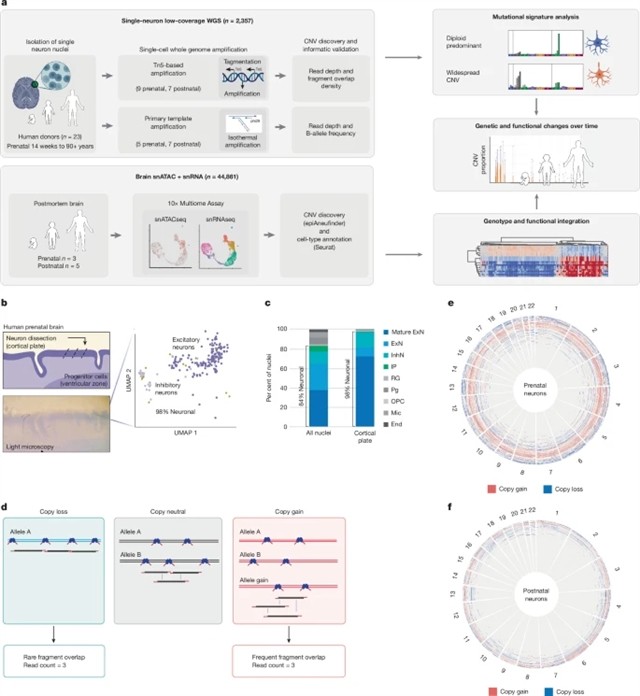
人类神经元是有丝分裂后且长寿命的细胞,需要精确的基因组调控。正常神经元功能高度依赖剂量,拷贝数变异(CNVs)和杂合点突变与多种神经发育和神经精神疾病相关。在此,研究人员研究了单神经元中产生的体细胞CNVs,以理解塑造正常神经元遗传景观的动态过程。总体而言,研究人员对来自胎儿至出生后人类死后脑组织的2,357个单神经元进行了测序。两种单细胞全基因组测序方法——基于Tn5转座酶的扩增(1,526个神经元,16个个体)和原始模板扩增(831个神经元,12个个体)——显示,平均25.9%[12.7–46%]的产前皮层神经元具有高度异常的基因组,即涉及多条染色体的广泛CNVs。在两种单细胞全基因组测序方法中,这一比例在出生后降低约4.5倍(Fisher荟萃分析P=3.5×10^6)。具有广泛CNVs的神经元主要在围产期被消除,时间大致与程序性细胞死亡时期平行,而CNV负荷较小的神经元频率随出生后年龄缓慢下降。存活神经元中的CNVs在剂量敏感基因和参与神经发育障碍的基因中耗竭(超几何检验P<0.05),提示具有这些CNVs的神经元被选择性消除。对44,861个细胞核进行转座酶可及染色质单核检测(snATAC)和单核RNA测序(snRNA-seq)分析显示,高CNV负荷的神经元表现出异常的突触基因表达,提示异常突触基因调控促成了神经元消除。缺陷神经元基因组的消除可能代表一个重要的发育基因组质量控制过程,该过程在神经发育疾病中可能易受损,并提示人类神经发育过程中的纯化选择。
附:英文原文
Title: Perinatal elimination of genetically aberrant human cortical neurons
Author: Shao, Diane D., Zhao, Yifan, Brew, Joseph, Adla, Yahia, Ghosh, Urmi, Viswanadham, Vinayak V., Luquette, Lovelace J., Zhao, Sijing, Kriz, Andrea J., Qian, Xuyu, Taketomi, Takumi, Coy, Shannon, Santagata, Sandro, Miller, Michael, Tsuruta, Fuminori, Park, Peter J., Walsh, Christopher A.
Issue&Volume: 2026-10-28
Abstract: Human neurons are postmitotic and long-lived, requiring precise genomic regulation. Normal neuronal function is highly dosage-sensitive, with copy number variants (CNVs) and heterozygous point mutations associated with a host of neurodevelopmental and neuropsychiatric conditions1,2,3,4. Here we investigated somatic CNVs arising in single neurons to understand the dynamic processes that shape the normal neuronal genetic landscape. Altogether, we sequenced 2,357 single neurons from human postmortem brain from fetal to postnatal life. Two single-cell whole-genome sequencing approaches—Tn5-transposase-based amplification (1,526 neurons, 16 individuals) and primary template amplification5 (831 neurons, 12 individuals)—showed that an average of 25.9% [12.7–46%] of prenatal cortical neurons have highly aberrant genomes, that is, widespread CNVs involving multiple chromosomes. This proportion reduced by about 4.5-fold after birth across the two single-cell whole-genome sequencing approaches (Fisher meta-analysis P=3.5 × 10⁶). Neurons with widespread CNVs were mainly eliminated perinatally, timed roughly parallel to periods of programmed cell death6, whereas neurons with smaller CNV burdens declined slowly in frequency with postnatal age. CNVs in surviving neurons were depleted for dosage-sensitive genes and genes involved in neurodevelopmental disorders (hypergeometric test P < 0.05), suggesting selective elimination of neurons with these CNVs. Analysis of 44,861 nuclei with single-nucleus assay for transposase-accessible chromatin (snATAC) and single-nucleus RNA sequencing (snRNA-seq) showed that neurons with high CNV burdens exhibited abnormal synaptic gene expression, suggesting that abnormal synaptic gene regulation contributes to neuronal elimination. Elimination of defective neuronal genomes might represent an important developmental genome quality-control process that may be vulnerable in neurodevelopmental disease, and suggests purifying selection during human neurodevelopment.
DOI: 10.1038/s41586-026-11190-3
Source:https://www.nature.com/articles/s41586-026-11190-3
Nature:《自然》,创刊于1869年。隶属于施普林格·自然出版集团,最新IF:69.504
官方网址:http://www.nature.com/
投稿链接:http://www.nature.com/authors/submit_manuscript.html