
近日,澳大利亚新南威尔士大学Joseph E. Powell等合作在研究中取得进展。他们揭示了稀有和常见遗传变异对单细胞免疫基因表达的影响。2026年10月28日出版的《自然》杂志发表了这项成果。
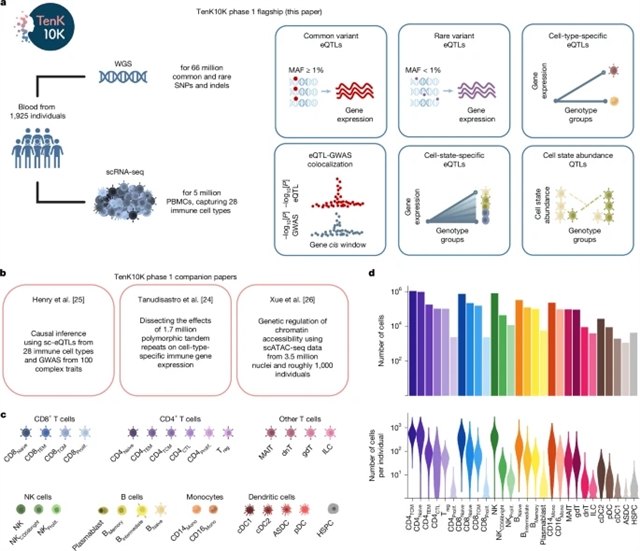
理解基因表达的遗传基础可以揭示复杂性状和疾病背后的调控机制。单细胞分辨的RNA水平测量和单细胞表达数量性状位点已揭示驱动不同组织中细胞状态和细胞类型的遗传调控。在此,研究人员描述了TenK10K的第一阶段,利用来自1,925名个体、涵盖28种免疫细胞类型的超过500万个细胞的单细胞RNA测序数据,以及匹配的全基因组测序数据。这为检测稀有和低频遗传变异提供了效力,这些变异对细胞特异性基因表达的影响在很大程度上尚未被表征。研究人员使用一种通过直接建模单细胞而非聚合的“伪批量”计数来提高效力的最新方法,以细胞类型特异性方式绘制常见和稀有变异的效应。他们为所检测的全部21,404个基因中的83%鉴定出推定的常见调控变异,并为其中47%的基因鉴定出累积的稀有变异信号。研究人员探索了遗传效应如何在细胞类型和状态之间变化,开发了一个确定单细胞表达数量性状位点细胞类型特异性程度的框架,并表明约一半的效应仅在一个或少数细胞类型中观察到。通过将结果与功能注释和疾病信息整合,研究人员进一步表征了许多疾病变异关联可能的分子作用模式。最后,他们探索了遗传变异对跨连续细胞状态的基因表达的效应,以及直接随细胞状态丰度变化的效应。
附:英文原文
Title: Rare and common genetic variants shape single-cell immune gene expression
Author: Cuomo, Anna S. E., Spenceley, Eleanor, Tanudisastro, Hope A., Bowen, Blake, Henry, Albert, Huang, Hao Lawrence, Xue, Angli, Zhou, Wei, Welland, Matthew J., Bryen, Samantha J., Dong, Oscar A., Lee, Arthur S., Pullin, Jeffrey M., Wing, Kristof, Tang, Owen, Gray, Michael P., Franklin, Michael, Harper, Michael, Silk, Michael, Bobowik, Katalina, Stuckey, Alexander, Marshall, John, Bakiris, Vivian, Uren, Caitlin, McCloy, Rachael A., Madala, Bindu Swapna, Miniter, Amy, Bartie, Caitlin, Neavin, Drew R., Qiao, Zhen, Ben-David, Eyal, Chen, Ling, Farh, Kyle Kai-How, Grieve, Stuart M., Nguyen, Tung, Wallace, Chris, Piscionere, Jennifer, Siggs, Owen M., Nicholas, Hannah, de Lange, Katrina M., Hewitt, Alex W., Figtree, Gemma A.
Issue&Volume: 2026-10-28
Abstract: Understanding the genetic basis of gene expression can shed light on the regulatory mechanisms underlying complex traits and diseases1,2. Single-cell-resolved measures of RNA levels and single-cell expression quantitative trait loci have revealed genetic regulation that drives cell states and types across diverse tissues3. Here we describe phase 1 of TenK10K, which leverages single-cell RNA sequencing data from more than 5million cells across 28 immune cell types, along with matched whole-genome sequencing data from 1,925 individuals. This provides power to detect associations for rare and low-frequency genetic variants that have largely been uncharacterized in their impact on cell-specific gene expression. We map the effects of both common and rare variants in a cell-type-specific manner using a recent method that increases power by modelling single cells directly rather than aggregated ‘pseudobulk’ counts. We identify putative common regulatory variants for 83% of all 21,404 genes tested and cumulative rare-variant signals for 47% of those genes. We explore how genetic effects vary across cell types and states, develop a framework to determine the degree of single-cell expression quantitative trait loci cell-type specificity and show that about half of the effects are observed only in one or a few cell types. By integrating our results with functional annotations and disease information, we further characterize the likely molecular modes of action for many disease-variant associations. Finally, we explore the effects that genetic variants have on gene expression across continuous cell states, and effects that vary cell-state abundance directly.
DOI: 10.1038/s41586-026-10721-2
Source:https://www.nature.com/articles/s41586-026-10721-2
Nature:《自然》,创刊于1869年。隶属于施普林格·自然出版集团,最新IF:69.504
官方网址:http://www.nature.com/
投稿链接:http://www.nature.com/authors/submit_manuscript.html