
2026年10月28日,日本海洋地球科学技术厅超尖端科学技术前沿生命研究所Masaru K. Nobu等科学家在《自然》发表研究,揭示真核生物最近的亲属是内部结构简单的互养型嗜肽古菌。
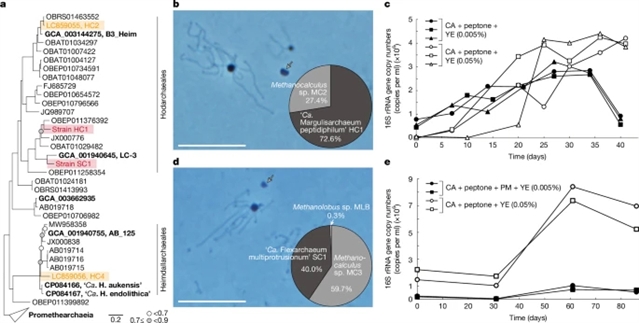
真核生物被认为其起源与古菌门Promethearchaeota(原Asgard古菌)相关。首批培养的代表性菌株揭示了宝贵见解,但它们仍与真核生物关系较远,真核发生仍有许多未知。在此,研究人员报告分离出两株HC1和SC1,它们属于分支最接近真核生物的古菌谱系Heimdallarchaeia;这些分离株是一个纯共培养物和一个与产甲烷伙伴组成的三培养物的成员。二者均为专性厌氧、互养、降解肽的嗜中温古菌,可产生突起和囊泡,但缺乏持久的内部膜结构,类似Promethearchaeales。所有Promethearchaeota分离株均表现出聚焦于细胞构建和膜结构而非分裂的行为,与典型原核生物相反。菌株HC1拥有与好氧生活方式相关的基因(如细胞色素c氧化酶Cox),但共培养物不能在(微)氧条件下生长。同时,在有氧生物存在时,该菌株可在微氧条件下生长,提示Cox支持氧解毒而非呼吸。比较基因组学提供证据表明,像HC1一样,迄今研究的拥有Cox的Heimdallarchaeia可能并不呼吸氧气。厌氧生活方式、无持久胞内膜的细胞结构以及膜突起在Promethearchaeota中广泛保守,提示真核生物的古菌祖先可能具有此类生理特征。在这一受培养研究启发的真核发生场景中,古菌向真核生物的转变将涉及细胞结构的急剧转变,以及从厌氧向(兼性)好氧的生理转变;古菌宿主与线粒体祖先之间的早期相互作用可能发生在低氧条件下,并至少部分由氧解毒所介导。
附:英文原文
Title: Eukaryotes’ closest relatives are internally simple syntrophic peptidotrophic archaea
Author: Imachi, Hiroyuki, Nobu, Masaru K., Ishii, Shunichi, Hashiguchi, Hiroki, Hirakata, Yuga, Hosogi, Naoki, Ikuta, Tetsuro, Isaji, Yuta, Miyata, Makoto, Miyazaki, Masayuki, Morono, Yuki, Murata, Kazuyoshi, Nakagawa, Satoshi, Narita, Akihiro, Ogawara, Miyuki, Okada, Satoshi, Saito, Yumi, Sakai, Sanae, Shimamura, Shigeru, Tahara, Yuhei O., Takaki, Yoshihiro, Takano, Yoshinori, Tasumi, Eiji, Uematsu, Katsuyuki, Yoshimura, Toshihiro, Takai, Ken
Issue&Volume: 2026-10-28
Abstract: Eukaryotes are theorized to have an origin associated with the archaeal phylum Promethearchaeota (formerly Asgard archaea)1,2,3. The first cultured representatives revealed valuable insights4,5 but are still distantly related to eukaryotes, leaving many unknowns regarding eukaryogenesis. Here we report the isolation of two strains, HC1 and SC1, that belong to the archaeal lineage that branches closest to eukaryotes (Heimdallarchaeia);6,7,8 these isolates are members of a pure co-culture and a tri-culture with methanogenic partners. Both are obligately anaerobic, syntrophic, peptide-degrading and mesophilic archaea that produce protrusions and vesicles but lack persistent internal membrane structures, like Promethearchaeales4,5. All Promethearchaeota isolates demonstrate behaviour focused on cell construction and membrane structures rather than division, in contrast to typical prokaryotes9. Strain HC1 possesses genes associated with aerobic lifestyles (such as cytochrome c oxidase (Cox)) but co-cultures cannot grow under (micro)oxic conditions. Meanwhile, the strain demonstrates growth under microoxic conditions when in the presence of aerobes, suggesting that Cox supports oxygen detoxification rather than respiration. Comparative genomics provides evidence that, like HC1, Cox-possessing Heimdallarchaeia studied to date probably do not respire oxygen. The wide conservation of anaerobiosis, cell structure without persistent intracellular membranes and membrane protrusions across Promethearchaeota suggest that the archaeal ancestor of eukaryotes may have had such physiological features. In this cultivation-informed scenario for eukaryogenesis, the archaea–eukaryote transition would involve a steep transition in cell structure and physiological shift from anaerobiosis to (facultative) aerobiosis10, with early interactions between the archaeal host and mitochondrial ancestor probably occurring under low-oxygen conditions and at least partially mediated by oxygen detoxification.
DOI: 10.1038/s41586-026-11170-7
Source:https://www.nature.com/articles/s41586-026-11170-7
Nature:《自然》,创刊于1869年。隶属于施普林格·自然出版集团,最新IF:69.504
官方网址:http://www.nature.com/
投稿链接:http://www.nature.com/authors/submit_manuscript.html